Physics and Mathematics of Topological Textures · Training School, 12–13 May 2025
Lecture Notes — Training School — Budapest 2025
Physics and Mathematics of Topological Textures
The first POLYTOPO Training School was held at the Budapest University of Technology and Economics on
12–13 May 2025. It introduced early-stage researchers to topological textures in magnetism, condensed
matter and light: from the physics of magnetic materials to the mathematical analysis of vortices and
domain walls, structured light, and numerical methods. The lecturers have kindly shared their notes,
which you can download below.
12–13 May 2025Budapest, Hungary4 lecturers3 sets of notes · source code
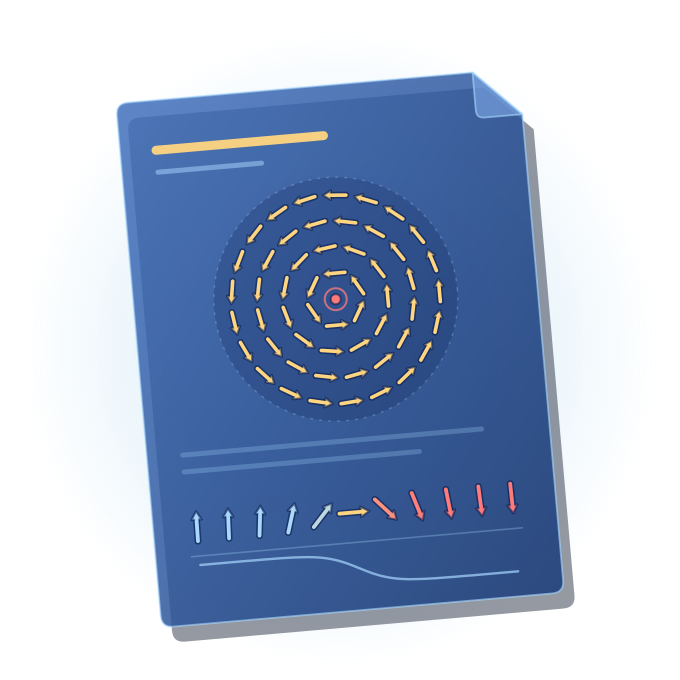
An introduction to topological textures from the side of magnetism: quantum spins and the Heisenberg model, the spin path integral and the Landau–Lifshitz equation, the continuum description of micromagnetics, and the classification of defects and textures by homotopy groups. Vortices, Bloch points, domain walls, merons, skyrmions and hopfions are discussed, with examples of materials in which they are found.
Vortices in the two-dimensional Ginzburg–Landau model, the prototype of many variational problems: the topological degree, the Jacobian that detects the vortices, and the renormalised energy that determines where they sit.
Domain walls as transition layers between two states: from the Allen–Cahn model to models of Ginzburg–Landau type with a divergence-free constraint, and the walls found in ferromagnets, such as Bloch, cross-tie and zigzag walls.
Generating and analysing polarisation textures in light
Two tutorials. The first presents methods for shaping and analysing light, from polarisation optics to spatial light modulators. The second treats optical skyrmions: their definitions, their properties and their measurement by Stokes tomography.
No notes are available for this course.
Related on this site, not part of the course: the interactive simulations Polarisation & Topology.
Practicals: Numerical energy minimization in magnetics
Energy minimisation with gradient-based methods, in particular the conjugate gradient method, and ways of keeping the spins on the unit sphere; then spatial discretisation and the dipole–dipole interaction. The C++ program written for the session implements several minimisation methods, so that their convergence can be compared.