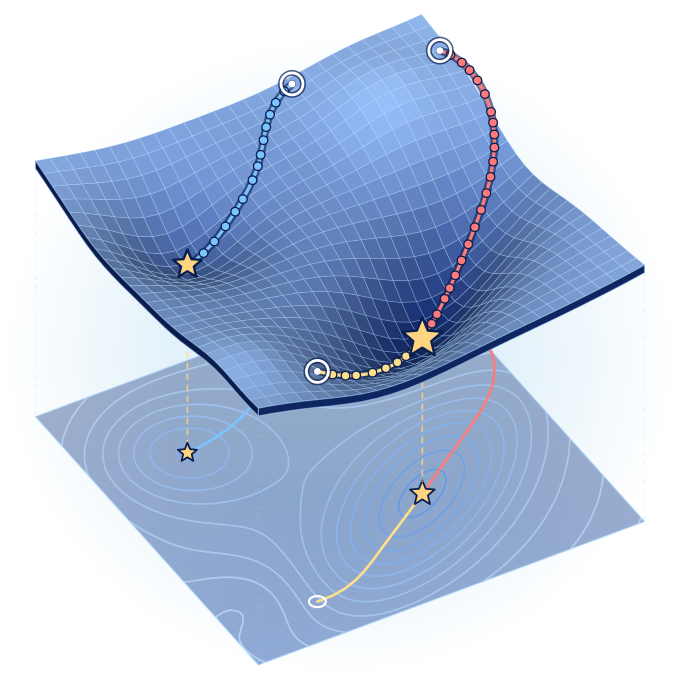
Three interactive simulations, from a valley on a map to a skyrmion in a magnet
POLYTOPO · Interactive Simulations
Energy Minimisation
Stable magnetic textures, such as domain walls and skyrmions, are states in which the energy of the
magnet has a minimum. To find them on a computer, one starts from a guess and walks downhill on the
energy landscape, step by step, until the slope vanishes. How the next step is chosen can make the
difference between a few steps and many thousands. These three interactive simulations follow the walk
from the simplest case to a model magnet: two variables on a map, eleven in a chain, and finally
2,304 spins, where the walk ends in a skyrmion.
New to the subject? Start with Part 1 and follow the parts in order.
Based on
The series grew out of the C++ program written by Philipp Rybakov (University of Uppsala, Sweden) for his practical session “Numerical energy minimization in magnetics” at the POLYTOPO Training School on Physics and Mathematics of Topological Textures, Budapest, 12–13 May 2025. Parts 1 and 2 adapt it for the web: the test energy and the implementation of all seven minimisation methods are taken from it. Part 3 applies the same ideas to a spin model that is not part of the code. The original source code is available for download and is used here with the author’s permission. We thank him for sharing it.
Created by
Yorgis Androulakis, IACM / FORTH: web adaptation of Parts 1 and 2; concept, design & development of Part 3.
Improve
Have a suggestion to improve these simulations? This email address is being protected from spambots. You need JavaScript enabled to view it. — all ideas are welcome.