The Poincaré sphere
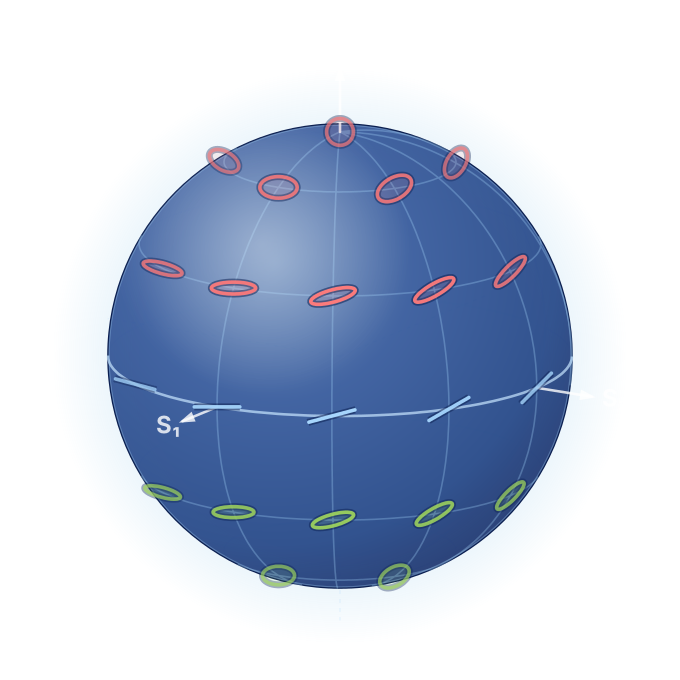
The Poincaré sphere and its stereographic projection
Every state of fully polarised light is a point on a sphere. Project that sphere from its north pole onto a plane and each point becomes a polarisation ellipse: lines on the equator, circles at the poles, and ellipses turning opposite ways in the two hemispheres. Follow the six short steps, or just drag the point and explore.
Based on an original Mathematica notebook by Miguel A. Alonso, presented at the POLYTOPO Heraklion Workshop 2026 (acknowledgement).
The ellipse in the beam
Landmark states
H, V, D, A lie on the equator. C+ and C− are the two circular states at the poles.
The state in numbers
Type any value and press Enter: the sphere follows. Stokes values are rescaled onto the sphere.
Conventions and assumptions
Light travels along +z with time dependence e−iωt. The Jones vector (Ex, Ey) gives S₁ = |Ex|² − |Ey|², S₂ = 2 Re(Ex* Ey), S₃ = 2 Im(Ex* Ey), normalised to |S| = 1.
Facing the source (σ = +1) shows x to the right and y up. Then S₃ > 0 turns anticlockwise. From behind (σ = −1) is the mirror image, so every sense reverses.
Textbooks disagree on the names. With the conventions above, S₃ > 0 (anticlockwise when facing the source, positive helicity) is left-circular in the traditional optics convention and right-circular in the engineering (IEEE) convention. That is why the poles are labelled C+ and C− here, by the sign of S₃.
The light is treated as a monochromatic, paraxial wave that is fully polarised, with its electric field at right angles to the direction of travel. The ellipse is the path of the tip of the field at one fixed point, with the amplitude set to 1. The ▶ Field animation is slowed down about 10¹⁵ times: visible light completes a cycle in roughly 2 femtoseconds.
How to use
- Drag the white point on the sphere, or drag the ellipse on the plane. Drag anywhere else to turn the scene.
- The six tour steps each end with a small task. The page checks it for you and ticks it off.
- ▶ Field animates the electric field. ⧉ Link copies a link to the current state, handy for teaching.
- Step 6 is a game: find the mystery state from its ellipse alone.
Reading the colours
Blue: on the equator. The ellipse collapses to a line and the field only oscillates (linear polarisation).
Red: the field turns anticlockwise in the current view. Green: clockwise. The two hemispheres turn opposite ways, and switching the view swaps them.
Why a sphere, and why project it?
A polarisation state is a Jones vector up to an overall complex factor (amplitude and phase), i.e. a point of the complex projective line ℂP¹. Topologically this is the 2-sphere: the Poincaré sphere.
Stereographic projection from the north pole identifies the sphere with the extended plane ℂ ∪ {∞}. It is conformal and sends circles on the sphere to circles or straight lines in the plane. With the sphere's radius as the unit of length, the equator lands on the circle of radius 2, and the north pole goes off to infinity.
The projected point is a complex number ζ whose size is twice the ratio of the two circular components, |ζ| = 2|E₊/E₋|, and whose angle is twice the tilt of the ellipse. Here E± = (Ex ∓ iEy)/√2 are the amplitudes of the circular components C+ and C−.
The doubled angles (φ = 2ψ, θ = 2χ) are the same doubling that links spinors to rotations (SU(2) → SO(3)), as in Dirac's belt trick in the Outreach section.
The formulas behind the picture
Point on the sphere (Stokes vector): S = (cos θ cos φ, cos θ sin φ, sin θ), with ψ = φ/2, χ = θ/2.
Jones vector, up to a global phase: E = (cos ψ cos χ − i sin ψ sin χ, sin ψ cos χ + i cos ψ sin χ)
Field in the beam, facing the source: x(t) = cos ωt cos χ cos ψ − sin ωt sin χ sin ψ y(t) = sin ωt sin χ cos ψ + cos ωt cos χ sin ψ (unit amplitude). From behind, x changes sign. Axis ratio tan |χ|.
Projection from N = (0, 0, 1) onto the plane z = −1: ζ = R eiφ, R = 2 tan(π/4 + χ) = 2 |E₊ / E₋|, with E± = (Ex ∓ iEy)/√2 and lengths in units of the sphere's radius.
This simulation is adapted from an original Mathematica notebook by Prof. Miguel A. Alonso (Institut Fresnel, Centrale Méditerranée & University of Rochester). He presented it in his talk “Covering spheres and higher order compact manifolds with optical fields” at the POLYTOPO Workshop on Emerging Applications of Topological Textures, Heraklion, Crete, 16–19 September 2026. We thank him for sharing it.
Yorgis Androulakis, IACM / FORTH
Have a suggestion to improve this simulation?